
Is Standard Milled Timber or Roundwood Timber Construction More Sustainable?
Sustainability is at the forefront of modern construction, with architects and builders striving to minimize environmental impact while maintaining structural integrity and longevity. One crucial consideration in sustainable building is the choice of timber: should we use standard milled timber or opt for roundwood timber construction? Let’s explore the sustainability of both options based on key factors such as extraction, transportation, building lifetime, and re-usability.
Extraction: The Impact of Cutting Down Trees
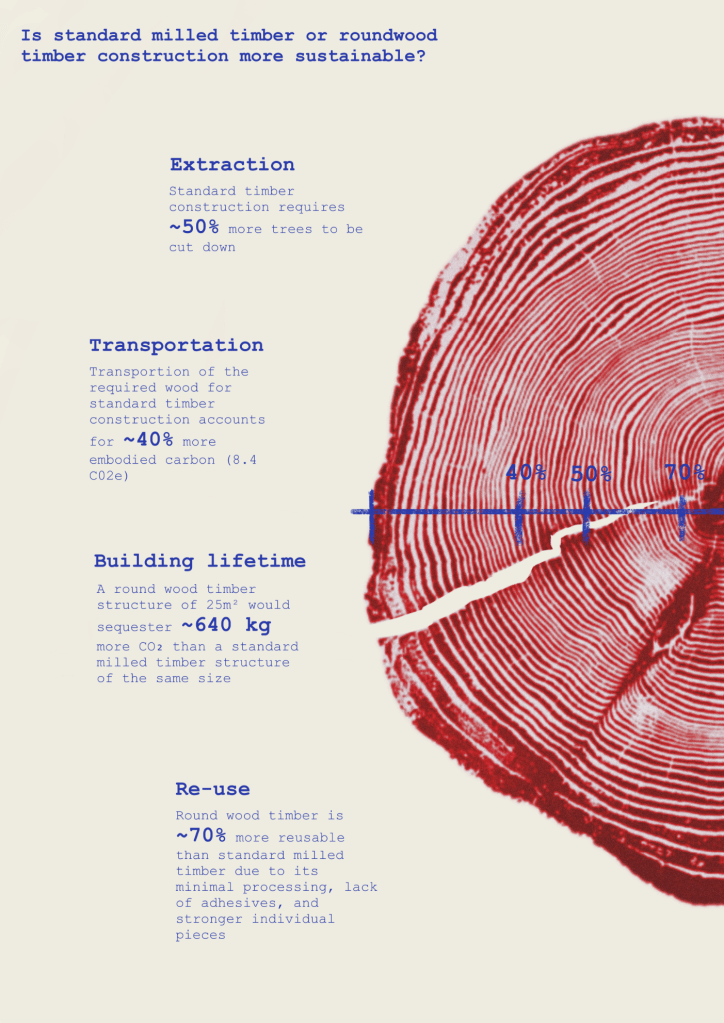
One of the fundamental aspects of sustainability is resource efficiency. Standard milled timber construction requires 50% more trees to be cut down compared to roundwood timber. This is primarily due to the extensive processing and shaping required to produce uniform planks and beams. On the other hand, roundwood timber makes use of more of the natural shape of the tree, reducing waste and preserving more of the forest.
Transportation: Embodied Carbon and Emissions
Transporting timber has a significant carbon footprint, often overlooked in discussions of sustainability. The additional processing and preparation needed for standard milled timber mean that more material is required, leading to an estimated 40% more embodied carbon emissions from transportation alone. In contrast, roundwood timber is used in a more natural state, requiring less processing and thus lowering overall emissions.
Building Lifetime: Carbon Sequestration and Longevity
Beyond the initial environmental impact, a building’s lifetime carbon sequestration is crucial. A 25m² roundwood timber structure can sequester approximately 640 kg more CO₂ than a similarly sized standard milled timber structure. This difference is significant, as carbon sequestration plays a key role in offsetting emissions and contributing to a net-zero construction approach.
Reusability: Maximizing Material Lifespan
Sustainability isn’t just about initial use but also about how materials can be repurposed at the end of a building’s life cycle. Roundwood timber is 70% more reusable than standard milled timber. This is due to its minimal processing, the absence of adhesives, and the inherent strength of the wood in its natural form. Standard milled timber, often treated with chemicals and adhesives, has a more limited potential for reuse, often ending up as waste or requiring significant processing before it can be repurposed.
Conclusion: The Clear Winner in Sustainability
When comparing standard milled timber and roundwood timber, the latter emerges as the more sustainable choice. It requires fewer trees to be cut down, has a lower transportation carbon footprint, sequesters more CO₂ over its lifetime, and is significantly more reusable. As we move towards greener construction practices, roundwood timber presents an excellent alternative that aligns with the principles of sustainability, resource efficiency, and carbon reduction.
For architects, builders, and homeowners looking to incorporate sustainable timber into their projects, choosing roundwood timber is a step toward a more eco-friendly future.
Looking to implement sustainable construction solutions? Visit www.prelimplans.com for expert guidance and planning support!
 PrelimPlans
Leave a comment